light
normal, angle of incidence, angle of reflection
the normal is a line perpendicular to a surface. angle of incidence is measured between incident ray and normal. angle of reflection is measured between reflected ray and normal.
law of reflection
angle of incidence equals angle of reflection. applies to all surfaces, with measurements taken from the normal.
3.2.1 | reflection of light
plane mirror images
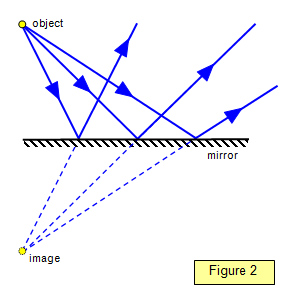
plane mirrors produce images that are: same size as object, same distance behind mirror as object is in front, virtual (cannot be projected on screen), upright, and laterally inverted (left-right reversed).
reflected ray calculations
use simple constructions and measurements to find reflected rays and image positions. draw normal at point of incidence, measure angle of incidence, mark reflected ray at equal angle on opposite side of normal.
refraction
change in direction of light when passing from one medium to another due to change in light speed. measured using normal, angle of incidence, and angle of refraction.
refractive index
n = sin(i) / sin(r), where i is angle of incidence and r is angle of refraction.
also n = 1 / sin(c), where c is critical angle. refractive index compares speed of light in different media.
another formula is n = v1/v2, where v1 is the speed before and v2 is the speed after.
3.2.2 | refraction of light
refraction through transparent blocks
light bends when entering and leaving transparent materials at different angles. demonstrated by observing light path through glass blocks or water. light bends toward normal when entering denser medium, away from normal when entering less dense medium.
reflected ray calculations
use simple constructions and measurements to find reflected rays and image positions. draw normal at point of incidence, measure angle of incidence, mark reflected ray at equal angle on opposite side of normal.
light passage through materials
when light passes through a transparent material, it refracts at the first boundary (entering the material) and again at the second boundary (leaving the material). the emergent ray is parallel to the incident ray but laterally displaced. the amount of displacement depends on the material's refractive index and the thickness of the material.
critical angle and total internal reflection
light traveling from denser to less dense medium may be completely reflected (total internal reflection) if angle of incidence exceeds critical angle. critical angle is the angle where refracted ray travels along the boundary (angle of refraction = 90°). everyday examples: light reflected in water surfaces, diamonds sparkle due to total internal reflection, mirages in deserts.
optical fibres
light travels through fibres by repeated total internal reflection. used in telecommunications to transmit signals over long distances. advantages: fast, reliable, and allows many signals simultaneously.

converging and diverging lenses
converging (convex) lenses bring parallel rays to a focal point. diverging (concave) lenses spread parallel rays as if from a focal point behind the lens.
focal length, principal axis, principal focus
focal length (f) is the distance from lens to focal point. principal axis is the line through center of lens perpendicular to its surface. principal focus (focal point) is where rays converge or appear to diverge.
3.2.3 | thin lenses
action of lenses on light
converging lenses bring parallel light rays together at focal point. diverging lenses spread parallel rays outward as if from a point behind the lens.
ray diagrams for real images
use three rays from object: ray through center of lens (undeviated), ray parallel to principal axis (refracts through focal point), ray through focal point (refracts parallel). where rays meet forms real image. real images can be projected on screen.
image characteristics
images formed by converging lenses can be: enlarged/same size/diminished, upright/inverted, real/virtual depending on object position relative to focal length.
virtual images from diverging lenses
ray diagram shows diverging lens producing virtual image. draw rays parallel to axis (diverges from back focal point) and ray through center (undeviated). virtual image is upright, diminished, and located between lens and focal point. cannot be projected on screen.
magnifying glass
single converging lens used as magnifying glass when object is between lens and focal point. produces enlarged, upright, virtual image. used for reading small print and examining details.
correcting vision defects
converging lenses correct long-sightedness (hyperopia) by adding focusing power. diverging lenses correct short-sightedness (myopia) by reducing focusing power. bifocals combine both types for different viewing distances.
all ray diagrams:

3.2.4 | dispersion of light
prism dispersion
white light entering a glass prism refracts at first surface, disperses into spectrum, and refracts again at second surface. different colors (wavelengths) refract by different amounts: red bends least, violet bends most.
visible spectrum
traditional order of colors in visible spectrum by frequency (highest to lowest): violet, indigo, blue, green, yellow, orange, red (VIBGYOR). also in order of increasing wavelength. each color corresponds to specific frequency and wavelength.
monochromatic light
visible light of single frequency is monochromatic (one color). has single, specific wavelength and frequency. differs from white light which contains all visible frequencies mixed together.