general properties of waves
features of a wave
- wavefront: line or surface of constant phase, perpendicular to direction of propagation
- wavelength (λ): distance between two consecutive points in phase (e.g., crest to crest)
- frequency (f): number of complete waves passing a point per second (measured in hertz, Hz)
- period (T): time taken for one complete wave to pass a point (T = 1/f)
- amplitude (A): maximum displacement from the mean position
- speed (v): distance travelled by the wave per second (v = fλ)

reflection of waves
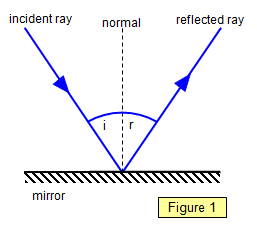
when a wave encounters a boundary between two different media, it may be reflected. the angle of incidence (i) is equal to the angle of reflection (r), measured from the normal to the surface.
refraction of waves
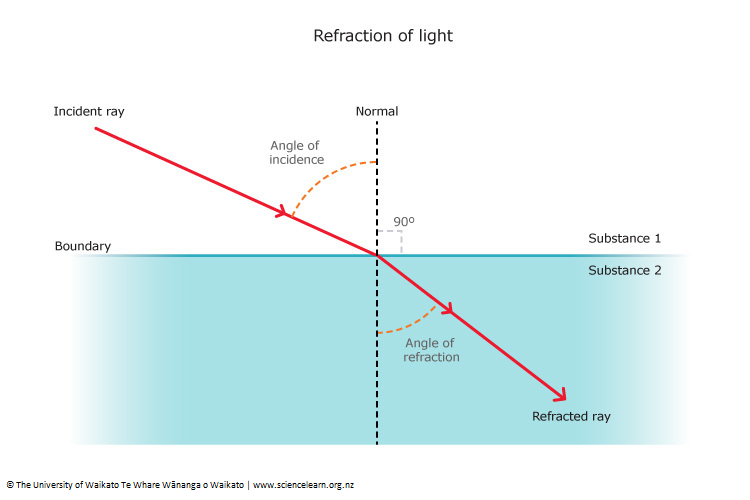
refraction occurs when a wave passes from one medium to another, causing a change in speed and direction. the relationship between the angles of incidence (i) and refraction (r) is given by snell's law: n1 sin(i) = n2 sin(r), where n1 and n2 are the refractive indices of the two media.
diffraction of waves
diffraction is the bending of waves around obstacles or through openings. the amount of diffraction increases with longer wavelengths and smaller openings relative to the wavelength.
wave motion
waves transfer energy without transferring matter. particles oscillate about equilibrium while energy propagates through the medium. demonstrated by vibrations in ropes and springs, and water waves.
wave speed
v = fλ, where v is wave speed, f is frequency, and λ is wavelength. wave speed depends on the medium, not on frequency or wavelength individually.
transverse waves
in transverse waves, particles oscillate perpendicular to the direction of wave propagation. examples include light waves and water waves.
longitudinal waves
in longitudinal waves, particles oscillate parallel to the direction of wave propagation. examples include sound waves and compression waves in springs.