3.2
non-uniform motion
non-uniform motion occurs when an object’s velocity changes with time. this can be a change in speed, direction, or both.
friction
- friction is a force that opposes motion
- it acts along the surface of contact between two objects
- friction is responsible for non-uniform motion
- friction always acts opposite to the direction of motion
viscous forces (drag)
- frictional force in a fluid is called a viscous force or drag
- fluids include liquids and gases such as water and air
- air resistance is a common example of drag
- drag force increases as the speed of the object increases
terminal velocity
when an object moves through a fluid, it may eventually reach a maximum constant velocity known as terminal velocity.
reaching terminal velocity
- initially, the only significant force acting is weight
- the object accelerates downward with acceleration
g - as speed increases, the upward drag force increases
- the resultant force is
weight − drag - the acceleration decreases as drag increases
- eventually, drag equals weight
- the resultant force becomes
0 - with zero resultant force, acceleration is zero
- the object continues to move at a constant terminal velocity
velocity–time graph
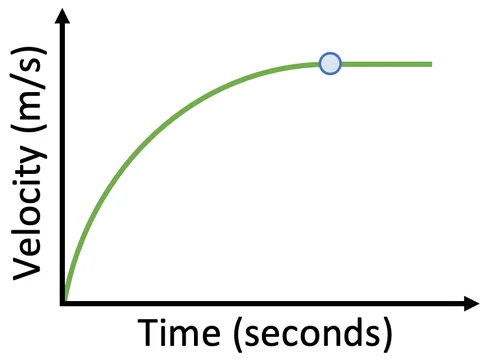
- the gradient of a velocity–time graph represents acceleration
- as drag increases, the gradient decreases
- at terminal velocity, the graph becomes horizontal
- a horizontal line indicates constant velocity and zero acceleration