3.1
momentum and newton’s laws of motion
relationships involving force and mass
- forces are vector quantities — they have both magnitude and direction
- a free-body diagram shows the forces acting on an object
- the resultant force is the combined effect of all forces acting on an object
- if forces are balanced, the resultant force is
0
forces and motion
- an object remains at rest or in constant velocity unless acted upon by a resultant force
- a resultant force is required to change velocity
- a change in velocity means a change in speed, direction, or both
newton’s laws of motion
first law
- an object continues in its state of rest or uniform motion unless acted upon by a resultant force
- this is sometimes described as inertia
second law
- acceleration is directly proportional to the resultant force
- acceleration is inversely proportional to mass
- acceleration is always in the same direction as the resultant force
F = ma
where:
F= resultant force (N)m= mass (kg)a= acceleration (m s⁻²)
third law
- when one object exerts a force on another, the second object exerts an equal and opposite force on the first
- these forces act on different objects
- they are known as action–reaction pairs
momentum
- momentum is the product of mass and velocity
p = mv- momentum is a vector quantity
- unit:
kg m s⁻¹orN s
newton’s second law in terms of momentum
- resultant force equals the rate of change of momentum
F = Δp / t- this is the more general form of newton’s second law
link to third law
- the rate of change of momentum of one object is equal and opposite to that of the other object
- this explains why action–reaction forces are equal in magnitude and opposite in direction
weight
- weight is the force due to gravity acting on a mass
W = mgg ≈ 9.81 m s⁻²- weight acts vertically downwards
when an object rests on a surface, its weight is balanced by a normal contact force.
identifying newton’s third law pairs
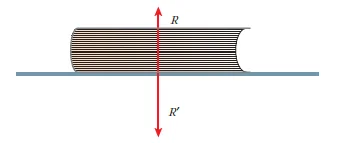
- forces must act on two different objects
- forces must be equal in magnitude
- forces must act in opposite directions
- forces must be of the same type
as shown in the diagram, R acts on the book, while R' acts on the surface. this means that this is a third law pair.