linear momentum and its conservation
principle of conservation of momentum
in an isolated system where no external resultant force acts, the total momentum remains constant.
- momentum is a vector quantity
- direction must be considered when solving problems
- total momentum before a collision equals total momentum after the collision
total momentum before = total momentum after
collisions
in any collision, momentum is conserved provided the system is isolated.
two-object collision (one dimension)
- consider motion along a straight line
- choose one direction as positive
- assign signs carefully to velocities
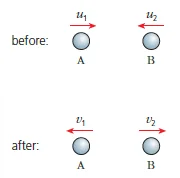
if two objects of masses m₁ and m₂ have initial velocities u₁ and u₂, and final velocities v₁ and v₂:
m₁u₁ + m₂u₂ = m₁v₁ + m₂v₂
momentum and impulse
- impulse is the product of force and the time for which it acts
- impulse equals the change in momentum
impulse = FΔt = Δp
- unit:
N s 1 N s = 1 kg m s⁻¹
elastic and inelastic collisions
collisions are classified based on what happens to kinetic energy.
perfectly elastic collision
- momentum is conserved
- kinetic energy is conserved
- relative speed of approach equals relative speed of separation
inelastic collision
- momentum is conserved
- kinetic energy is not conserved
- some kinetic energy is converted to heat, sound, or deformation
energy in collisions
total kinetic energy before collision:
½m₁u₁² + ½m₂u₂²
total kinetic energy after collision:
½m₁v₁² + ½m₂v₂²
in a perfectly elastic collision:
½m₁u₁² + ½m₂u₂² = ½m₁v₁² + ½m₂v₂²
even when kinetic energy is not conserved, total energy and total momentum are always conserved in an isolated system.