errors and uncertainties
1.3.1 types of error
all measurements are affected by error. errors can be grouped into two main types: systematic errors and random errors.
systematic errors
systematic errors cause measurements to be consistently too large or too small. they shift all readings in the same direction.
- systematic errors affect accuracy
- repeating measurements does not reduce systematic error
- they are often caused by faulty equipment or poor calibration
examples include:
- zero error on a measuring instrument
- incorrect scale calibration
- consistent reaction time delay
random errors
random errors cause readings to vary unpredictably about a true value.
- random errors affect precision
- they cause scatter in repeated measurements
- random error can be reduced by taking repeated readings and averaging
1.3.2 accuracy and precision
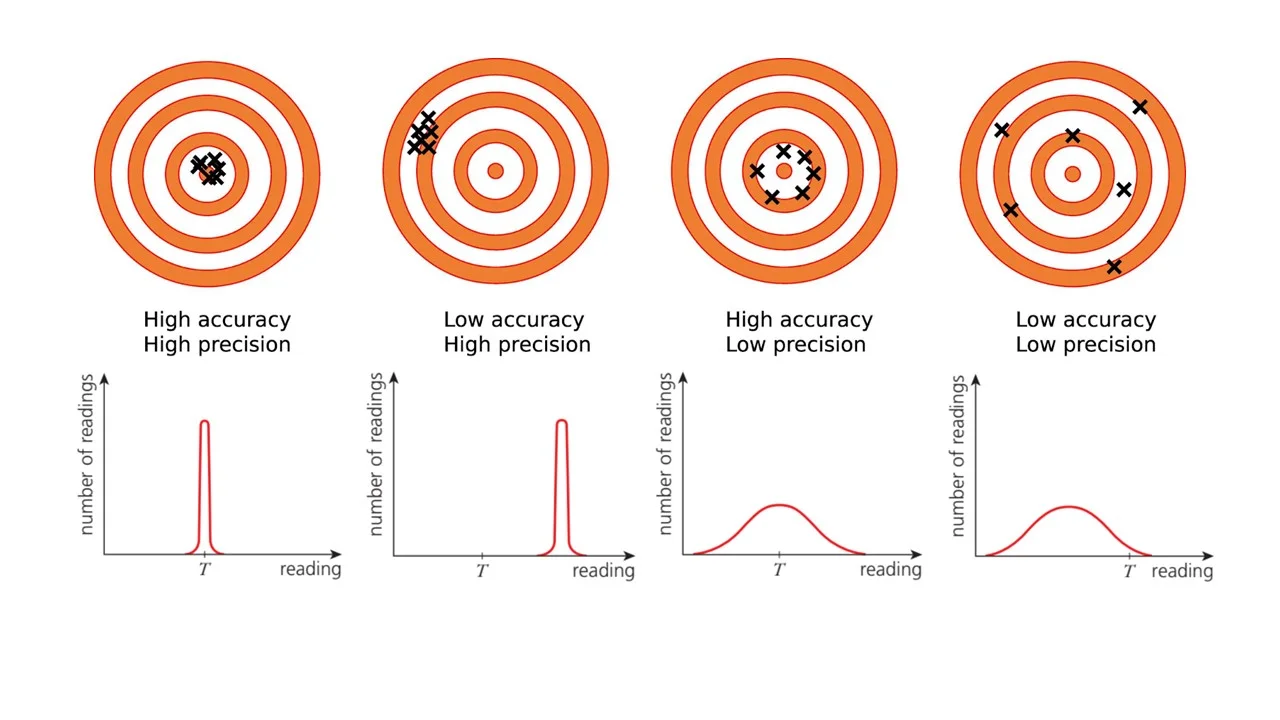
accuracy and precision describe different aspects of measurement quality.
accuracy
- how close a measurement is to the true value
- mainly affected by systematic errors
precision
- how close repeated measurements are to each other
- mainly affected by random errors
a set of measurements can be precise but not accurate, or accurate but not precise.
1.3.3 uncertainty in measurements
uncertainty is an estimate of the range within which the true value is expected to lie.
- uncertainty is often given as an absolute value
- it may also be expressed as a percentage
for a single reading from an analogue scale, uncertainty is typically
± half the smallest scale division.
1.3.4 adding and subtracting uncertainties
when quantities are added or subtracted, absolute uncertainties are added.
if q = a ± b, then:
uncertainty in q = uncertainty in a + uncertainty in b
example:
if a = 5.0 ± 0.1 and b = 3.0 ± 0.2
then q = 8.0 ± 0.3
1.3.5 uncertainties in derived quantities
when quantities are multiplied or divided, percentage uncertainties are added.
percentage uncertainty = (absolute uncertainty / measured value) × 100%
for a derived quantity:
total percentage uncertainty = sum of individual percentage uncertainties
the absolute uncertainty in the final result is then found by converting the percentage uncertainty back into an absolute uncertainty.