scalars and vectors
1.4.1 scalar and vector quantities
physical quantities can be classified as either scalars or vectors.
scalar quantities
scalar quantities have magnitude only.
| quantity | symbol |
|---|---|
| mass | m |
| time | t |
| energy | E |
| power | P |
| speed | v |
vector quantities
vector quantities have both magnitude and direction.
| quantity | symbol |
|---|---|
| displacement | s |
| velocity | v |
| acceleration | a |
| force | F |
| momentum | p |
1.4.2 addition and subtraction of coplanar vectors
coplanar vectors lie in the same plane and can be added graphically.
addition of coplanar vectors
- vectors are added using the head-to-tail method
- the resultant vector is drawn from the tail of the first vector to the head of the last vector
if two vectors act in the same direction, their magnitudes add directly.
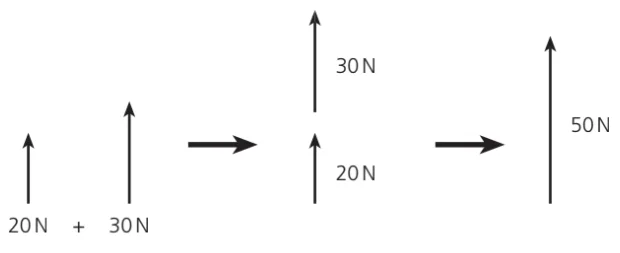
example:
20 N + 30 N in the same direction gives a resultant of 50 N
subtraction of coplanar vectors
- subtraction is equivalent to adding a vector in the opposite direction
- the direction of the resultant depends on the larger magnitude
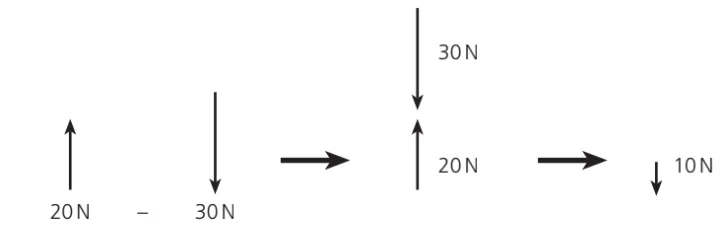
example:
30 N − 20 N gives a resultant of 10 N in the direction of the 30 N force
1.4.3 addition of non-coplanar vectors
when vectors are not in the same plane, they cannot be added using simple collinear methods.
vectors are added using the head-to-tail method in two dimensions.
- each vector is drawn to scale
- the angle between vectors must be included accurately
- the resultant vector is labelled
R
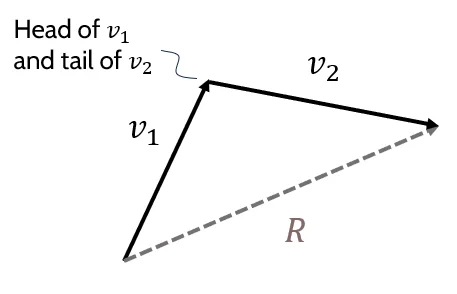
the magnitude and direction of R are measured from the diagram.
1.4.4 resolving vectors
resolving a vector means splitting it into two perpendicular components.
components are usually resolved horizontally and vertically.
for a vector F at an angle θ to the horizontal:
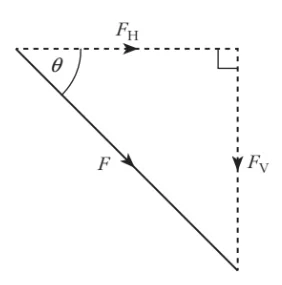
- horizontal component:
Fₓ = F cos θ - vertical component:
Fᵧ = F sin θ
the original vector can be found by combining its perpendicular components.
resolving vectors simplifies analysis of motion and forces in two dimensions.