2.3
two dimensional motion (projectile motion)
a projectile is an object that moves under the influence of gravity alone. this results in a curved path called a parabolic trajectory.
projectile motion is analysed by resolving the motion into two independent components at right angles to each other.
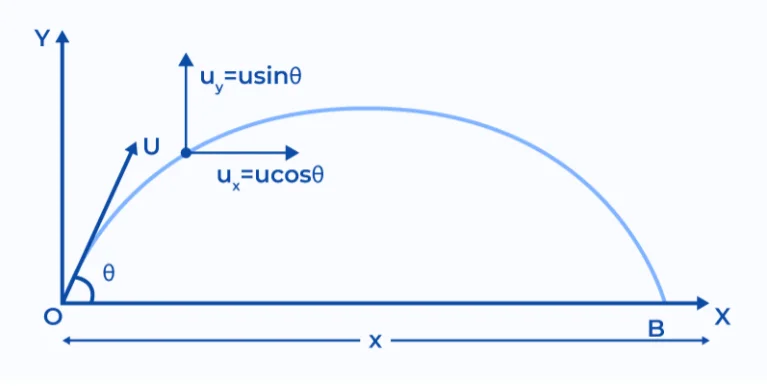
horizontal component of motion
- the horizontal component of velocity is written as
v_x - there is no horizontal acceleration if air resistance is neglected
- this means
v_xremains constant throughout the motion - horizontal displacement can be found using
x = v_x t
vertical component of motion
- the vertical component of velocity is written as
v_y - the vertical motion is affected by gravity
- the acceleration is the acceleration of free fall,
g gacts downwards and has a value of approximately9.81 ms⁻²
the horizontal and vertical motions are independent, but they share the same time of flight.
resolving the initial velocity
- if the projectile is launched with speed
uat an angleθ - horizontal component:
u_x = u cos θ - vertical component:
u_y = u sin θ
motion equations used in projectile problems
the standard equations of motion are applied separately to the horizontal and vertical directions.
- vertical velocity:
v_y = u_y + at - vertical displacement:
s = u_y t + ½at² - horizontal displacement:
x = v_x t
maximum height
- at maximum height, the vertical velocity is zero:
v_y = 0 - this condition is used to calculate the time to reach maximum height
- the vertical displacement equation is then used to find the maximum height
time of flight
- the time to reach maximum height is half the total time of flight
- total time of flight:
t_total = 2t_max
horizontal range
- the horizontal range is the total horizontal distance travelled
- it is calculated using
x = v_x t_total - the constant horizontal velocity simplifies the calculation